GEO: The Real Estate Marketing Game Changer You Can't Ignore

GEO: The Real Estate Marketing Game Changer You Can't Ignore
Your property isn’t invisible — but it might be to AI. Imagine a prospective renter — let’s call her Maya — opens her phone and types into ChatGPT: “What are the best luxury apartment communities near downtown San Diego?” She doesn’t open Zillow. She doesn’t Google anything. She just asks, reads the AI’s answer, and starts forming her shortlist. Here’s the scary part: if your property isn’t in that AI response, you don’t exist in Maya’s world. Not invisible on page two of Google results. Actually gone. This isn’t a future scenario. It’s happening right now — to homebuilders, multifamily operators, and property managers across the country. And the brands that figure it out first? They’re going to own the conversation for years to come.
Is Your Property Invisible to AI? Here's What You Need to Know
WELCOME TO THE ERA OF GEO
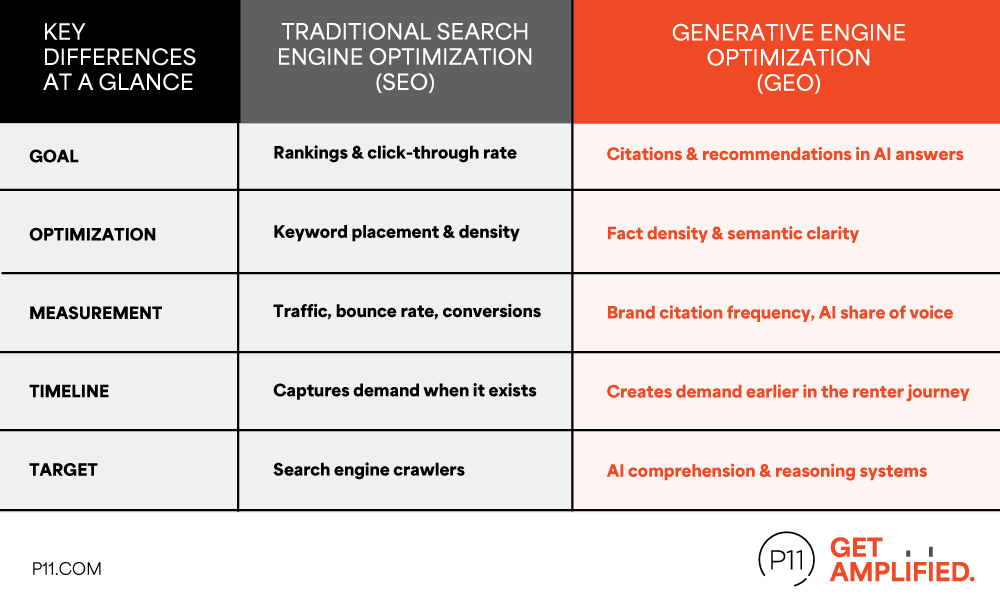
You’ve heard of SEO — Search Engine Optimization, the practice of making sure Google can find and rank your website. GEO, or Generative Engine Optimization, is the next evolution. Instead of optimizing for clicks and keyword rankings, GEO is about ensuring your brand is cited, recommended, and trusted by AI-powered answer engines like ChatGPT, Google Gemini, and Perplexity. Think of it this way: SEO asks, “Can they find us?” GEO asks, “Will AI recommend us?” That’s a fundamentally different question — and it requires a fundamentally different strategy.
WHY RIGHT NOW? (NO, SERIOUSLY — RIGHT NOW)
Answer engines aren’t a niche tech trend. They’ve hit the mainstream — hard. Google Gemini is now the default AI for over 2 billion users. Perplexity draws more than 1 million daily queries. And SearchGPT is fully integrated into ChatGPT, one of the fastest-growing platforms in internet history. These aren’t just search tools. They’re the new front door to your property’s digital presence.
For multifamily marketing specifically, the implications are massive. Studies show that AI-generated answers reduce traditional organic clicks by 30–50%. That means the traffic your SEO budget used to deliver is quietly being rerouted through AI intermediaries — and if you’re not optimized for those intermediaries, you’re paying for reach you’re no longer getting. Meanwhile, AI search adoption is accelerating fastest among the exact audiences multifamily and homebuilder marketers care most about: younger renters and buyers, relocating professionals, and digitally native decision-makers who’d rather converse with AI than scroll through sponsored listings.
AI-generated answers now reduce traditional organic clicks by 30–50%. That’s not a trend. That’s a tidal wave.
THE REAL-WORLD STAKES FOR MULTIFAMILY OPERATORS
Here’s a real-world scenario that should get every multifamily marketer’s attention. When someone types “best luxury apartments in San Diego” into Perplexity or ChatGPT, the AI generates a shortlist — with names, descriptions, and even personality. Properties that have invested in GEO appear on those shortlists. Properties that haven’t? They’re missing from the conversation entirely, even if they’ve spent a fortune on paid media and SEO. The compounding effect here is real. AI engines form citation habits early. According to a 2024 Search Engine Land analysis on AI brand visibility, brands that establish authority in AI answers early are significantly harder to displace later — a pattern analogous to how early SEO adopters dominated Google results for years. Once your competitor owns the AI narrative in your market, unseating them gets expensive.
For homebuilders, the stakes are just as high. When a relocating buyer asks ChatGPT for the best new-home communities near Austin or Phoenix, the AI synthesizes everything it can find about each builder’s reputation, product offerings, and online presence. If your digital signals are scattered or inconsistent, the AI simply won’t recommend you — even if your homes are spectacular.
SO, WHAT DOES GEO ACTUALLY LOOK LIKE?
Think of GEO as teaching AI to understand, trust, and talk about your properties. It works across three straightforward layers — and you don’t need to be a tech person to get it:
Make Your Properties Easy for AI to Read
Behind the scenes, your website sends signals that help AI engines understand what you offer and where you’re located. Getting those signals right is like giving AI a clear, organized fact sheet about your properties — instead of a messy room, it has to guess its way through.
Write Content That AI Wants to Quote
AI systems look for short, specific, factual content they can confidently repeat to users. A sentence like “This community features a rooftop pool, concierge services, and pet-friendly policies in downtown San Diego” is exactly what AI loves to cite. Vague brand copy is not. GEO is also about writing for AI readers, not just human ones.
Build a Reputation AI Can Verify
AI engines are more likely to recommend brands they’ve seen referenced in multiple credible places — reviews, local listings, third-party sites, press. The stronger your reputation across the web, the more confident AI is in recommending you. Think of it as building trust at scale.
THE COST OF WAITING (AND IT’S NOT CHEAP)
Here’s where we’ll be blunt: not investing in GEO right now isn’t a neutral decision. It’s an active choice to let competitors shape the AI narrative in your markets. And once those patterns solidify, catching up is significantly more expensive than getting ahead.
CONSIDER WHAT HAPPENS IF YOU DELAY
Your competitors become the default AI recommendations in your markets Your paid media budget has to work harder to reach renters that AI has already funneled elsewhere. Your portfolio appears as a collection of disconnected properties rather than a unified brand, which eliminates the portfolio-level competitive advantage you’ve worked hard to build. You miss the first-mover window that early SEO adopters caught in 2005 — and we all know how that played out. According to a 2026 roundup of 60+ verified AI search statistics compiled by Superlines, Gartner projects a 25% decline in traditional search engine volume by 2026 — and that same research shows 54% of U.S. marketers plan to implement GEO within the next three to six months. For multifamily marketing teams still allocating 100% of their digital budget to traditional SEO and paid search, those numbers should be a serious wake-up call. Answer engines are forming opinions about your portfolio right now — based on whatever signals they can find. Don’t let silence be your strategy.
MEASURING WHAT MATTERS IN AN AI-FIRST WORLD
One of the trickiest parts of GEO is that traditional metrics won’t capture it. Traffic, bounce rate, and click-through rate don’t tell you whether AI is recommending your brand. That’s why GEO requires a new measurement mindset:
• Brand Citation Frequency: How often do your properties appear in AI-generated answers?
• AI Share of Voice: How does your citation rate compare to competitors in your markets?
• Citation Quality Score: When AI mentions you, is it prominent, favorable, and accurate?
• Answer Nugget Performance: Which specific content blocks are getting cited most frequently?
These aren’t theoretical metrics. They’re the new indicators of brand visibility in an AI-first discovery landscape — and they compound over time in your favor when you invest early.
WHY P11 IS BUILT FOR THIS MOMENT
P11 has been obsessing over AI search behavior since the early days of answer engines. GEO isn’t a service we bolted on after reading a trade article — it’s baked into every website audit, content strategy, and digital recommendation we make. And because real estate is our sole focus (no retail clients, no B2B tech accounts, no one-size-fits-all playbooks), our GEO strategies are built specifically for the complexity of portfolio marketing, Fair Housing compliance, and multi-market property visibility.
We’ve built and managed digital marketing systems across 70+ property portfolios. We know how to scale efficiently without losing what makes each community unique. And we know how to make AI engines see your portfolio as the authority it already is.
READY TO OWN THE AI CONVERSATION IN YOUR MARKETS?
The brands that move now will be the ones AI recommends tomorrow. Whether you’re managing 5 properties or 100, P11 can help you audit your current AI visibility, identify where your competitors are winning the answer engine game, and build a GEO strategy that compounds over time. Don’t wait for your competitors to own the shortlist. Let’s get your portfolio top of mind. Let's amplify your success today!
LEARN MORE ABOUT P11'S VISIBILITY SOLUTIONS.
See How We Turn Ideas Into Results
Related Articles
Stay updated with the latest trends, strategies, and best practices in real estate marketing.




%20(1).png)

Partner with P11 to turn your real estate brand and properties into powerful marketing machines.